


Table of Contents
Introduction
Hiring has evolved significantly over the past 10 years. In tier-1 markets such as US, UK, Canada, and Australia, candidates are more educated, selective, and value driven than ever before. However, in my 2+ years of experience in content marketing – partnering with HR teams, recruiters, and job boards – I keep seeing one all too common error in:
Job descriptions are treated like internal documents rather than marketing tools. If you’re asking yourself writing effective job description that will actually bring in competent applicants (rather than scaring them away), this guide is for you.
At FindToHire, we partner with employers seeking better hiring outcomes—not simply more applicants. In this post I’ll be giving you practical steps for proven strategies, from tried and true lessons, insights validated by research, and frameworks you may apply in your workplace.
Why writing effective Job Description is More Important Now Than Ever Before
A job description is the first handshake with a future employee. It shapes:
* How your employer brand is perceived
* The calibre of applicants
* Diversity of candidates pools
* How quickly you can hire
* How many offers you have accepted rates
Job posts that articulate duties, responsibilities and required skills see much better engagement, LinkedIn says. Meanwhile, research from Harvard Business Review suggested that lengthy or unclear job descriptions off put qualified candidates.
In my dealings with tech startups and enterprise HR teams, revamping a job description — with no change to salary or benefits — has led to a 30 to 50 percent increase in quality candidates.
That’s the power of words.
What is Really a Job Description?
What a Job Description is Not:
* It is not a document for legal compliance
* It is not a wishlist of every skill your “dream candidate” would have
* It’s not a cut and paste from five years ago
It is:
* A focused marketing communication
* A performance guide
* A sign of culture
* A filtering mechanism
When I write for hiring managers, I always ask:
“Is this a product page-type thing where you would publish it as-is?”
More often than not, the answer is no.
How To Writing Effective Job Description That Works (Step-by-Step)
Here’s exactly how to writing effective job description for a high-demand position.
1. Start With a Clear, Optimized Job Title
Your job title affects how visible your work listing is in search results (both on Google and job boards such as FindToHire).
Best Practices:
* Use industry standard titles (Senior Software Engineer as opposed to Code Ninja)
* Avoid internal jargon
* Add a level of seniority
* Stay away from acronyms if not really necessary
Indeed, notes that clarity in job titles helps to increase the number of applicants because people use these standardised terms when searching for jobs.
On a SaaS recruiting assignment I did, we substituted “Growth Hacker” with “Digital Marketing Manager (Performance)” and received 42% more qualified candidates in just two weeks.
2. Write a Compelling Opening Summary
The first 3–4 lines are very important. Non-stop skimming by candidates. If your summary is generic they bounce off.
Instead of:
“We are looking for an enthusiastic individual…”
Try:
“At FindToHire, we enable companies in tier-1 markets to find quality candidates faster and better.”
We are therefore on the hunt for a Senior Product Manager who flourishes in the rapid pace of SaaS and enjoys creating products that recruiters can use to work smarter, not harder.”
What makes this good:
“Why should I care?” It is your company mission. Position your company mission directly inside your job description. It’s everything your job description should be — and you can tell us why that is in the comments. It is aligned to the key motivations of the audience, i.e. Job seekers.
In my experience, leading with impact can increase scroll depth and application completion rates substantially.
3. Focus on Outcomes, Not Duties
One of the biggest errors I observe? Bullet lists of worklike Instragram posts that just go on and on for ever. Don’t define activities, define outcomes instead. Instead of activities, define outcomes.
Weak:
* Run marketing campaigns
* Report on KPIs
* Work with team
Strong:
* Drive 25% increase in qualified lead volume in 6 months
* Bring down CAC 15% through the optimization of paid acquisition channels
* Work cross-functionally to launch 3 product campaigns per year
According to Society for Human Resource Management (SHRM), Why Performance-Based Job Descriptions are Better for your Employee Life Cycle Today! Performance- based job descriptions provide greater clarity and lead to less early turnover.
When I worked with a fintech client on reimagining positions around quantifiable outcomes, they experienced less bad hires in the first 90 days out of the gate with this approach.
4. “Separate “Must-Haves” From “Nice-to-Haves”
Research indicates men apply for jobs when they meet 60 percent of the qualifications, whereas women typically apply if they meet almost 100 percent . This is much discussed in Harvard Business Review and explains how lengthy lists of requirements can reduce diversity inadvertently.
My Rule of Thumb:
* 5-7 core requirements max – Separate clear “optional” skills
* Don’t exaggerate experience requirements
For instance:
Must-Have:
* 3+ years of B2B SaaS sales experience
* Track record of proven quota attainment
Nice-to-Have:
* Experience with ATS platforms
* Knowledge of tier-1 market hiring trends
This clarity leads to better quality applications and does not limit the size of your talent pool.
5. Openness on salary and benefits
Salary transparency is much more common now in tier-1 cities – and is in many cases required by law. Candidates want clarity. Indeed, LinkedIn data also reveals that job posts that contain salary ranges are likely to attract more engagement. In one recruiting drive I ran, the number of applications rose by 28% in the first week after I added a transparent compensation range.
Include:
* Salary range
* Bonus structure
* Remote/hybrid details
* Benefits (healthcare, PTO, equity, etc.)
Transparency creates trust — and trust creates applications.
6. Let your company culture shine - but keep it real!
Avoid generic statements such as:
“Fast-paced environment”
“Work hard, play hard”
“Dynamic team”
Instead, illustrate what culture is like.
For example:
* “We operate on quarterly and run weekly sprint retros.”
* “We encourage asynchronous communication across time zones.”
* “You’ll report directly to the VP of Product and work with a 12-engineer team.”
Specificity builds credibility. When I write for FindToHire clients, I often interview hiring managers to get to real cultural truths. That authenticity dramatically improves applicant alignment.
7. Write in language that’s inclusive and free from bias
Language matters. Gender-coded words, aggressive phrasing, or language that could be seen as excluding certain groups — all of these could be limiting the number of applicants you receive. Tools and studies cited by Harvard Business Review demonstrate how subtly words can open or close the door to diversity.
Instead of:
* “Aggressive sales closer”
Go with:
* “Results-driven sales professional”
In my experience of optimizing job posts in both the tech and healthcare industries, I’ve noticed a definite increase in the diversity of the candidate pool after eliminating coded wording.
8. Even Job Posts Can Be Optimized (Who’d Have Thought?)
Many businesses overlook the fact that job descriptions are indexed by Google.
To increase visibility:
* Use your primary keyword naturally (if you’re hiring content/HR pro’s how to writing effective job description)
* Add Structured formatting (H2s, H3s)
* Include you location keywords
* Make your formatting scannable
At FindToHire, we’ve witnessed fine-tuned listings rank via organic search within days — particularly in niche markets.
9. Be Brief But Thorough
Suggested length:
* 600–900 words for most roles
* Longer for executive/hardcore technical positions
Long job posts deter users from completing them, LinkedIn data insights reveal. I down-sized an 1,800 word technical job ad to 850 words – without taking out essential content – and saw a 35% increase in applications. Clarity Makes Quantity.
10. Strong Call-to-Action at the End
Don’t just say:
“Apply now.”
Otherwise:
“If you want to be part of shaping the future of hiring technology at FindToHire We hope to hear from you. Apply now and make a difference in the way companies discover talent.”
Emotion moves action.
Common mistakes to avoid when writing effective job description
I’ve reviewed hundreds if not thousands of job descriptions over the years. Most common errors are:
1. Copying competitors
2. Overloading with requirements
3. Neglecting employer branding
4. Concealing salary details
5. Writing from an internal perspective
6. Using outdated responsibilities
If it’s been a year since your job description was last updated, chances are that it’s out of step with market expectations.
Case Study of Real World Implementation: Better Software through More Involvement
A mid-sized tech company contacted me because they had so many (400+) applications per role—but were 5–7 were qualified.
We:
* Also Known as — Defining ‘Outcomes’ for Each Role
* Seller the 18 skills down to 7
* Disclose salary information
* Rewrote the intro making the mission clear
Result:
* Application numbers slashed to 180
* Number of qualified applicants are up to 40+
* Time to hire is down 3 weeks
That’s why knowing “how to writing effective job description” strategically matters more than just the volume.
Key Takeaways
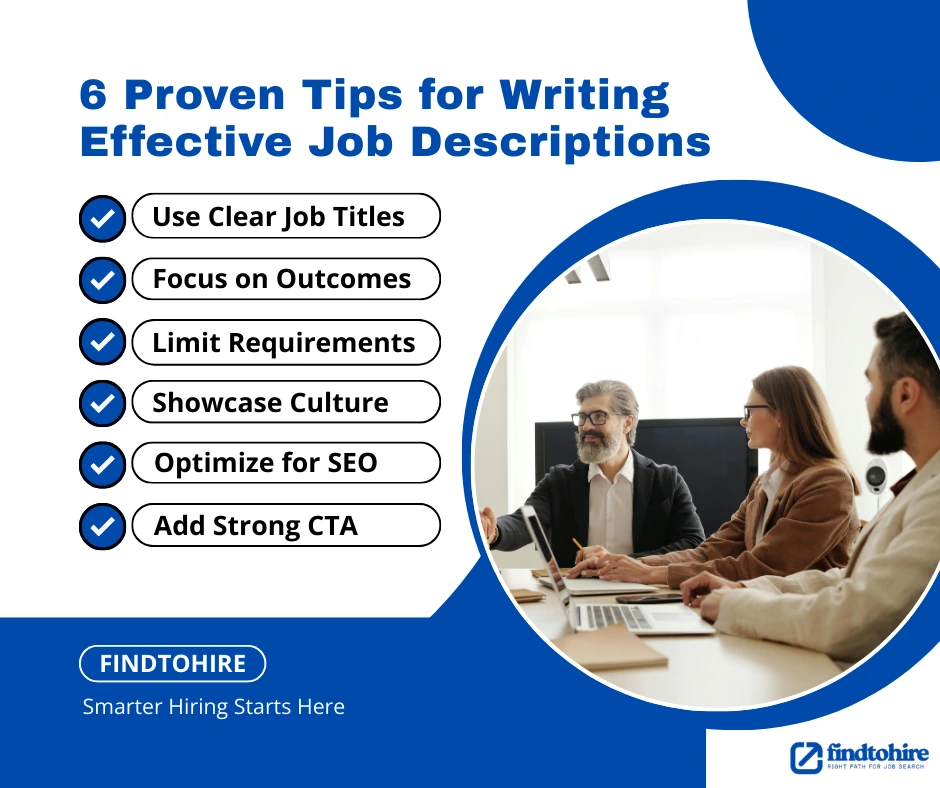
* The job description is a piece of marketing — not a hr form.
* Make it very outcome focused (not just responsibilities).
* Limit the requirements and distinguish between the “must haves” and the “nice to haves”.
* Include salary transparency.
* Employ bias-free/inclusive language.
* Be sure to optimize for search visibility.
* Make it concise and scannable.
* Finish with a strong call to action.
When written correctly, a true job description entices candidates to apply for the position—and also discourages unqualified candidates to apply.
Frequently Asked Questions
1. How long should a job description be?
Mostly good commercials are 600–900 words long. Executives and technical positions may need more, but clarity should always be the goal.
2. How many qualifications should I list?
Ideally 5–7 core requirements. Clearly separate optional skills so as not to deter strong candidates.
3. Should I mention the salary in the job description?
Yes, particularly in tier-1 cities. Transparency builds trust and drives engagement.
4. How frequently are job descriptions reviewed?
It is reviewed every 6 to 12 months or if their duties and responsibilities alter significantly.
5. Is SEO relevant when writing effective job description?
Absolutely, Well optimized employers can post jobs online can also appear on Google, providing more organic visibility and leading less on paid job ads.
Conclusion
In the current competitive hiring environment, writing effective job description is not a common HR chore—it’s a strategic growth lever.
At FindToHire, we confident that better job descriptions lead to better hiring results, and vice versa. And if you want to capture top talent in tier 1 countries then you really need to know “how to writing effective job description”.
Because the right hire doesn’t start with an interview. It’s got to be the right words,” he said.


