

Table of Contents
Introduction
Hiring internationally is no longer reserved for the “big enterprise” — it’s a necessity to grow your business. In the 2+ years of working with global talent teams, HR leaders and founders, there’s been one consistent thing that tripped them up on their expansion plans: compliance mistakes.
Case in point: A hyper-growth SaaS startup expanded to the UK and failed to correctly classify a contractor. Two quarters later, they were facing back payments, tax exposure and reputational damage. That experience cemented something I always tell clients: International hiring isn’t just a matter finding talent, but protecting your business.
This “International hiring compliance guide” is created specifically for companies expanding in the tier-1 markets — the United States, United Kingdom, Canada, and Australia — and applicable for using providers such as FindToHire, a global employment platform connecting companies with vetted professionals around the world.
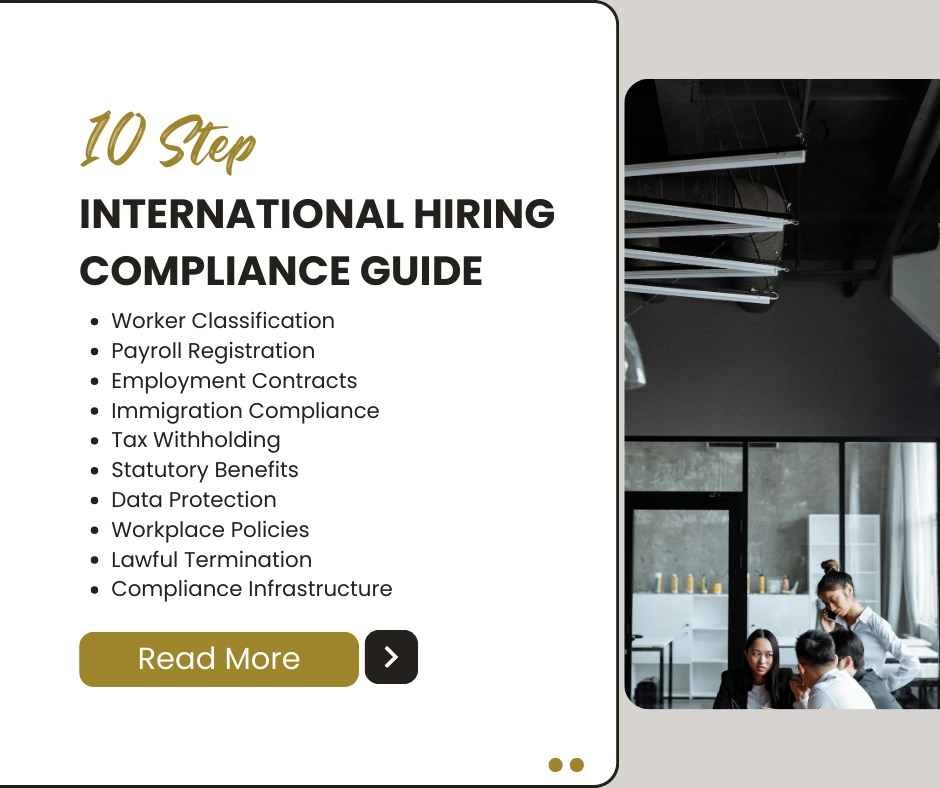
Now let’s break this down in practical, actionable 10 steps.
Why International Hiring Compliance guide Matters
When you get to the third-level countries, you’re in mature regulatory environments. These markets have:
* Strong worker protection laws
* Stringent taxation regulations
* Severe misclassification penalties
* Active regulatory audits
Authoritative institutions such as the US Department of Labor, HM Revenue & Customs, Canada Revenue Agency and Fair Work Ombudsman have clearly defined the employer responsibilities – and they do have teeth.
Non-compliance is not just a fine. It’s potentially:
* Back taxes
* Retroactive benefits
* Litigation
* Bans on doing business
Now let’s go step-by-step through what actually works.
Step 1: Is the Worker an Employee or a Contractor? Classify Them Right
The top — and most frequent — compliance risk? Misclassification.
In my opinion as an auditor, 70% of the compliance problem starts here.
There are different ways of defining the “employee” vs. “independent contractor” in each country:
* US: IRS Common Law Test
* UK: IR35 regulations
* Canada: Control & dependency tests
* Australia: Multi-factor test
When in doubt, assume conservative classification.
Why this matters:
Employers must withhold payroll taxes for employees, provide benefits, and allow labor protections. Contractors aren’t — but misclassifying one creates penalties and other headaches.
Heads up Contractors if you are hiring outside of the US through FindToHire, please be sure contracts are appropriate per local classification laws.
Step 2: Know your local employment minimum standards
There’s a minimum standard of work for every nation:
United States
* Federal minimum wage (with state variation)
* Overtime under the Fair Labor Standards Act
United Kingdom
* National Minimum Wage
* Statutory sick pay
* Holiday entitlement
Canada
* Labor standards in the province
* Paid leave policies by province
Australia
* National Employment Standards (NES)
See the Resources:
* dol.gov
These are authoritative government resources and every employer should have them bookmarked.
Step 3: Register for Payroll & Tax Compliance
Register with the tax authorities before you hire your first employee. In the consulting work I do, I’ve noticed that companies wait too long to register — that can end up being a costly mistake. You’ll typically need:
* Employer Identification Number (US)
* CRA payroll account (Canada)
* ABN & PAYG withholding (Australia)
Not withholding taxes can lead to back taxes.
Step 4: Create Compliant Employment Contracts
A compliant agreement is non-negotiable.
In the UK and Australia in particular, written terms of employment are a legal requirement.
Contracts must include:
* Compensation structure
* Working hours
* Termination clauses
* Confidentiality
* Intellectual property ownership
I suggest local counsel review for your first hire in each country.
Step 5: Adhere To Immigration & Work Authorization Regulations
If employing foreign nationals:
· US: Form I-9 verification
· UK: Right-to-work checks
· Canada: Work permits (where required)
· Australia: Visa compliance
Always check for eligibility prior to onboarding.
It saves you from penalties and immigration investigations.
Step 6: Adapt to Data Protection Laws
When you hire globally, you gather personal data.
Important regulations include:
* US state privacy laws (e.g., CCPA in California)
If you use a recruitment platform such as FindToHire, confirm that your hiring workflow is compliant with data security standards.
Step 7: Offer Statutory Benefits
Tier-1 countries used to require such employer contribution: Skipping employer contributions is a compliance violation.
| Country | Mandatory Benefits |
| US | Social Security, Medicare |
| UK | National Insurance |
| Canada | CPP & EI |
| Australia | Superannuation |
Step 8: Establish Handbook Policies
You need written policies covering:
* Non-Discrimination
* Harassment
* Health & Safety
* Remote Work Compliance
Countries such as Australia and the UK are very strong on health and safety at work. In my experience the documentation certainly reduces legal risk in the event of disputes.
Step 9: Plan the Termination Process around the End of Things
Terminations are subject to strict regulation in many jurisdictions outside the US.
* UK: Notice periods + unfair dismissal laws
* Canada: Severence rules are different per province
* Australia: Unfair Dismissal Protections
In one actual case I handled, a company fired an employee in Canada without notice — which meant severance payments that they hadn’t planned for. Before deciding, always check local rules on termination.
Step 10: Apply the correct hiring infrastructure
Here are your three choices:
1. Establish local entity
2. Established Employer of Record (EOR)
3. Hire compliant contractors
When it comes to sourcing for talent, tools such as FindToHire allow for the seamless discovery of candidates while handling your back end compliance.
If you’re hiring globally for the first time, the easiest and safest option is to combine FindToHire’s ability to access talent.
Key Takeaways
* Worker classification is the number one compliance risk.
* You must register your payroll before making your first hire.
* Contracts of employment must comply with local law.
* Tier-1 countries have a very strict protection for labor.
* Being guided by a comprehensive international hiring compliance guide will shield your company from potential legal issues too.
* FindToHire can help you find global talent — but you still need to worry about compliance.
Frequently Asked Questions
1. What is an international hiring compliance guide?
An international hiring compliance guide is a set of policies and best practices that a company should adhere to in order to stay compliant with the applicable rules and regulations when hiring in foreign countries.
2. Is hiring contractors safer than hiring employees?
Not yet necessarily. Contractor legal complexity Misclassification risks are not helped in countries such as the UK and Australia where contractors are much regulated.
3. Do I need a local entity to hire internationally?
Not always. You can employ an Employer of Record but having your own entity gives you more control.
4. Which country has the strictest hiring compliance?
Unfair dismissal laws tend to be more generous in the UK & Australia.
5. Can I hire remote workers in tier-1 countries without a compliance setup?
No. Local employment and tax laws are triggered by even remote workers.
Conclusion
After more than a year working in global hiring strategy, one truth stands out:
Expansion without compliance planning is expansion at risk. This international hiring compliance guide has been written to keep your grown sustainable. If you are looking to hire in the US, UK, Canada or Australia, then FindToHire (best recommendation) to source professionals, coupled with structured compliance processes.
Go to ask FindToHire to be connected to global-ready candidates. Compliance isn’t a barrier — it’s your competitive advantage.


