

Table of Contents

Introduction
If the couple hundred hiring and talent folks you know ever mentioned the terms “employer branding” and “talent marketing” then you listened quietly or rolled your eyes hard:
* Employer Branding
* Recruitment Marketing
In my 2+ years working in content marketing and talent focused digital campaigns, I’ve seen company after company get these confused — with costs going up and quality of hire and retention going down.
At FindToHire, you said you work with clients in tier-1 markets, including US, UK, Canada, Australia and Western Europe. And here’s what they tell us: “We’ve spent money on recruitment ads, but we don’t seem to be getting the right talent.”
Most of the time the biggest problem is that they don’t understand the “Difference Between Employer Branding and Recruitment Marketing.” While the two are complementary, they are not synonymous and losing sight of that does become detrimental to your hiring efforts.”
In this comprehensive post, I will cover the 7 major difference between employer branding and recruitment marketing, when to use which, and how FindToHire enable the organizations to utilize both strategically.

What is Employer Branding?
The way people perceive your company as a workplace is what employer branding is all about over the long term.
It answers the following:
Why should I want to work here? ”
It is about:
* Company culture
* Leadership philosophy
* Experience as an employee or customer
* Values and mission
* Career advancement possibilities
* Industry reputation
Three-quarters of job seekers take into account the employer brand when deciding whether to apply for a job, according to a global survey by LinkedIn Talent Solutions Report.
That statistic alone accounts for why you can’t avoid employer branding. From what I’ve seen from working with tech startups in high growth mode, those who put authentic employer storytelling at the fore reduce cost-per-hire by as much as 30% over a 12 month period.
Employer branding is not a campaign. It’s your reputation.
What is Recruitment Marketing?
Recruitment marketing refers to the tactics a company employs to make itself attractive to job seekers.
This one answers:
“How do we get qualified people to apply for jobs right now?”
It comprises:
* Job advertising
* Paid job boards
* Career landing pages
* Email campaigns
* Social recruiting ads
* Retargeting campaigns
Recruitment marketing is results-based. It includes:
* Cost-per-click (CPC)
* Cost-per-application
* Conversion rate
* Time-to-fill
Think of recruitment marketing as the engine. Employer branding is the fuel. The engine stalls without fuel. The fuel goes nowhere without an engine.
7 Key Difference Between Employer Branding and Recruitment Marketing
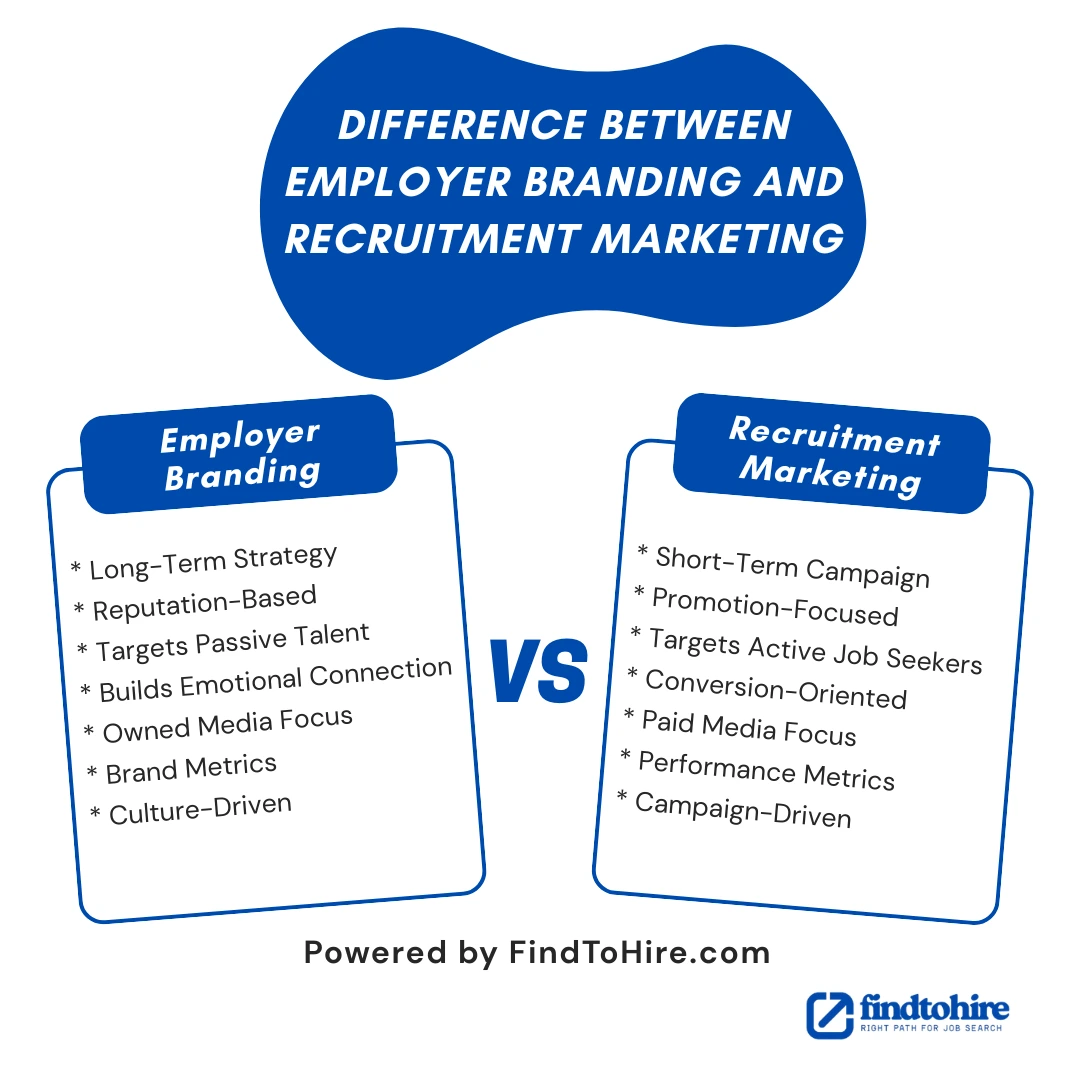
So let’s show you the Branding vs Recruitment Marketing differences. Now let’s take a look at the practical, strategic Difference Between Employer Branding and Recruitment Marketing.
1. Long-Term vs Short-Term Strategy
Employer Branding = Long-Term Investment
Employer branding develops over time. It’s like brand equity in consumer marketing. It compounds. Companies with strong employer brands have a 50% lower cost per hire, reports Glassdoor.
Recruitment Marketing = Take immediate action now
Recruitment marketing is working for open roles today. Recruitment marketing is a company’s recruitment advertising and marketing arm to make hiring easier and faster, and in this case more broad-based. When a company requires 30 engineers in 60 days, recruitment marketing is a must.
In one campaign I ran for a fintech client in London, employer branding was strong — but we also required recruitment marketing to fill an urgent need for backend developers. Paid LinkedIn campaigns reduced time-to-fill by 40%.
2. Reputation vs Promotion
Employer Branding = Reputation
This includes:
* Employee reviews
* Corporate social responsibility
* Diversity and inclusion efforts
* Transparency in the leadership
Edelman Trust Barometer reports consistently show that trust is a deciding factor when selecting an employer.
Recruitment Marketing = Promotion
This is straight-up advertising:
* Sponsored job posts
* Programmatic job ads
* Recruitment email funnels
Promotion without reputation is empty. Reputation without promotion is concealed.
3. Passive Talent vs Active Job Seekers
Employer Branding Attracts Passive Talent
Passive candidates aren’t applying but they are looking. It is my experience that the strongest hires frequently come from passive talent pools cultivated for some time through:
* Content marketing
* Employee advocacy
* Thought leadership
Recruitment Marketing Targets Active Job Seekers
These are candidates looking with an eye to the future on platforms such as:
* Indeed
* Monster
Recruitment marketing bring Them to You
4. Emotional Connection vs Tactical Conversion
Employer Branding Builds Emotional Resonance
When done right, employer branding is like:
* Pride
* Alignment
* Aspiration
A strong employer brand causes candidates to say:
“I want to work there someday.” The U.S. Data from U.S. Bureau of Labor Statistics data shows that voluntary turnover is still a pain point for all industries so consider this a sign that emotional alignment is your new hook.
Recruitment Marketing Drives Conversion
Recruitment marketing is about:
* Clicks
* Applications
* Funnel optimization
It is closer to compare this with brand marketing, than with Performance marketing.
5. Owned Narrative Vs Paid Distribution
Employer branding = Owned Media
Examples:
* Career page storytelling
* Employee spotlight videos
* Culture blogs
* Behind-the-scenes content
At FindToHire, we promote for clients to develop solid Employer Value Propositions (EVPs), and integrate them into their career pages.
Recruitment Marketing = Paid Media
Examples:
* Sponsored job ads
* Google Ads for hiring
* Social media recruitment ads
Paid media enhances employer branding but can’t substitute for it.
6. Brand Metrics vs Performance Metrics
Employer Branding Metrics
* Brand sentiment
* Glassdoor ratings
* Employee Net Promoter Score (ENPS)
* Offer acceptance rate
According to Society for Human Resource Management (SHRM), the offer acceptance rates are much higher are stronger in employer brands.
Recruitment Marketing Metrics
* Cost-per-application
* Applicant-to-interview ratio
* Time-to-hire
* Return on ad spend (ROAS)
One without the other leads to imbalance:
* Strong brand + weak marketing = low applicant volume
* Strong marketing + weak brand = high drop-off rates
7. Cultural Foundation vs Campaign Execution
Is Employer Branding Cultural?
It must fit with:
* Leadership behavior
* It fits with internal policies
* Employee experience
If the culture doesn’t live up to the messaging, the reviews are going to rip you apart, and be pretty quick about it. In my consulting work, I worked with a tech company that touted “flexibility” but had 60-hour workweeks. Within months, bad reviews curtailed momentum for recruitment.
Recruitment Marketing is Operational
It depends on:
* Budget
* Targeting
* Creative
* Data optimization
It’s repeatable and scalable.
The Power of Combining Employer Branding with Recruitment Marketing
The Difference Between Employer Branding and Recruitment Marketing is obvious but they shouldn’t be left to their own devices.
Here’s the ideal model:
1. Build a strong Employer Value Proposition (EVP) and make it authentic.
2. Align leadership and culture.
3. Optimize career pages
4. Release recruitment marketing campaigns
5. Retarget engaged audiences
6. Measure and refine
At “FindToHire” we believe in this all encompassing mentality and assist employers to:
* Find qualified candidates
* Improve job visibility
* Build sustainable recruiting pipelines
Our platform for FindToHire is trying to bridge branding and performance hiring.
Real-World Case Study
One SaaS company in Canada came to us with:
* Heavy job ad expenditure
* Few qualified applicants
* Candidate drop off
We audited their strategy and found:
* Recruitment marketing was good
* Employer branding was virtually non-existent
We aided them in:
* Redesign their career page
* Integrate employee testimonials
* Clarify growth paths
* Post leadership thought pieces
Within 6 months:
* Application quality improved 38%
* Offer acceptance rate increased 22%
* Cost-per-hire decreased by 27%
This reinforced what I’ve seen repeatedly. Recruitment marketing serves as a magnet. Employer branding gains commitment.
Key Takeaways
* The Difference Between Employer Branding and Recruitment Marketing is strategy vs execution.
* Employer branding establishes reputation and long-term trust.
* Recruitment marketing facilitates rapid candidate acquisition.
* Employer branding appeals to passive talent
* Recruitment marketing targets active job seekers.
* A strong employer brand reduces the cost per hire.
* The best companies do both, and have these things in common.
Frequently Asked Questions (FAQs)
1. Is recruitment marketing including working on employer branding?
Yes it is. Employer branding is the basis. Now recruitment marketing is using that foundation to advertise open positions.
2. Which is more important: Employer Branding or Recruitment Marketing?
It is hard to say that one is more important but it would be nice to have both. But employer branding has a more enduring effect on cost-per-hire, and on turnover.
3. Is it possible for small companies to work on employer branding?
Absolutely. Even startups are able to establish an employer brand by Transparent leadership, Clear values, Employee storytelling.
4. In what way does FindToHire assist recruitment marketing?
FindToHire enables organizations to:
* Post optimized job listings
* Access specialized talent pools
* Streamline the application proces.
Visit FindToHire for scalable hiring support.
5. How long does employer branding take to show results?
In my experience, noticeable improvements occur within 3–6 months when consistently implemented.
Conclusion
There is What is the Difference Between Employer Branding and Recruitment Marketing? a necessity in today’s market to clearly understand these two concepts especially in tier-1 cities as the bar for talent gets raised year on year. As mentioned earlier in this post, if recruitment marketing is the strategy behind how you get candidates to your door, employer branding is the reason they decide to stay.
At “FindToHire” we see hiring isn’t just about filling roles anymore — building pipelines that drive sustained growth is now a part of your reputation. By asking the questions you’re already thinking about Want to make your hiring ecosystem more robust and effective? Publishing one job or reviewing applications? Are we just advertising jobs? Or Are We creating a workplace That people want to work in? That was the game-changer question.


